Blog
April 2011
Out Like a Lamb?
April 13, 2011
Where I grew up in Connecticut, the expression, “March comes in like a lion and goes out like a lamb,” generally holds true. As does the old saying that, “April showers bring May flowers.” I would imagine that there are already some early daffodils blooming in New England.
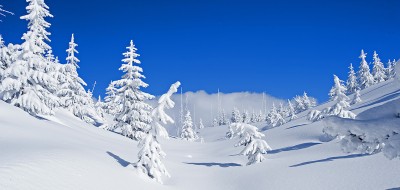
However, March and April in southeast Idaho only bring to mind the all-too-familiar term,“cabin fever.” At 6300 feet above sea level, Island Park is buried in the throws of winter each year until Mother’s Day at the earliest, and this winter has been one of the harshest in recent years. In order to endure the seemingly endless winter, one must learn to embrace the unique beauty that winter brings, and to take advantage of any break in the weather. There are all sorts of winter
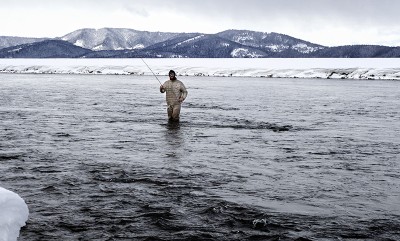
recreational opportunities in Island Park for those willing to wear a fewextra layers; snowmobiling, cross country skiing, bird-watching, drinking at the TroutHunter Bar, and, of course, fly fishing. Jonathan Heames and I recently took advantage of a balmy 35 degree March day and floated the Box Canyon. This is the first winter that Idaho Fish & Game has allowed winter catch & release fishing in the Box--the perfect cure for a pair of fly fishing guides suffering from the winter doldrums. The boat ramp is obviously not plowed, so we launched my RO skiff from the dam road, and pushed it on top of the ample snow all the way down to the boat ramp, dropping several layers of clothing (and a few choice words) along the way.

The hard work getting the boat in the water was soon forgotten, as healthy rainbows rewarded us for our efforts. The water was cold and fish did not want to move to a swung streamer. However, they ate nymphs readily all the way to TroutHunter, where Jon Stiehl used the horsepower of his snowmobile to pull the driftboat from the river. Ending the day with a draft beer and a hickory burger at TroutHunter Bar, while reminiscing on the day’s fishing, it almost……..almost…….felt like June.
-Pat Gaffney
Comments (2)
A BIG Winter
April 12, 2011
A Big Winter by Rene' Harrop. April 2011.
With nearly sixty six years under my belt, I have learned to recognize the value of a winter that arrives early and stays late. With human misery not withstanding, a six month season that builds snow to amazing depth in the high country is a gift to those who prize fishing the Henry's Fork above nearly anything else in life.
Residents who do not evacuate the area with the first hint of frost understand that snow in great abundance is not a villian, and its benefits far exceed the inconvenience of spending half a year in a world of white.
With a snow pack that began to accummulate last October, water experts report precipitation levels at 120% of average in the Henry's Fork drainage as of April 1, and it is still growing. This level is the highest in fourteen years, and it comes on the heels of three consecutive years of adequate winter precipitation. And despite flows averaging from 350-400 cfs for most of the winter, Island Park Reservoir stands at 75% of capacity. It should also be noted that sub-zero temperatures did not appear to have caused the kind of severe icing that has impacted the fishery in some years during the past decade.
With winter flows and temperatures as key factors in determining trout survival, it is logical to assume that the recent upturn in the quality of fishing on the Henry's Fork will continue through the 2011 season. This may also be the year when recruitment from the reconnection to the Buffalo River becomes noticeable in the main stem of the river. Idaho Fish and Game surveys in late May should help to clarify how this Henry's Fork Foundation coordinated project factors into the trout population of the Caldera section of the Henry's Fork.
Also anticipated in the coming months are preliminary results of an HFF study that would determine the feasability of reconnecting Silver Lake in Harriman State Park with the Henry's Fork.
With higher flows during spring runoff a certainty, we are looking forward to conditions that concentrate big browns and rainbows along the edges of the lower river during the Salmon Fly hatch in late May and early June. Locals also work on the assumption that higher spring flows in this area bring heavier hatches of Gray Drakes, and they prepare accordingly.
In low water years, trout are not well dispersed in Harriman State Park until aquatic vegetation begins to mature in early summer. Hatches of Brown and Green Drakes also seem to be especially affected when winter and spring flows are less than ideal. In 2011, the June 15 opening of the Ranch should benefit from an abundance of water that is favorable to both trout and angler as another season gets underway.
While any prediction is largely a matter of guess work, it is impossible to not recall 1997 which is the last time we have seen such generous precipitation in the Henry's Fork Basin. And while reluctant to forecast a similar result with respect to a momentous spike in trout population and an amzing five year span of fishing that followed the winter of 1997, it will be interesting to see if such history is repeated in 2011.
Though most signs are positive looking forward, there is one item affecting the future of the Henry's Fork that is not being celebrated as good news. After nine years of serving as Executive Director, Steve Trafton is leaving the Henry's Fork Foundation to accept a position with Trout Unlimited in Washington D.C.
The list of Steve's accomplishments on behalf of the river is far too long to list at this time, and his leadership will be sorely missed. I wish him well in his new position and offer my personal thanks for all he has done to protect the values we hold dear. He will be hard to replace.
With nearly sixty six years under my belt, I have learned to recognize the value of a winter that arrives early and stays late. With human misery not withstanding, a six month season that builds snow to amazing depth in the high country is a gift to those who prize fishing the Henry's Fork above nearly anything else in life.Residents who do not evacuate the area with the first hint of frost understand that snow in great abundance is not a villian, and its benefits far exceed the inconvenience of spending half a year in a world of white.
With a snow pack that began to accummulate last October, water experts report precipitation levels at 120% of average in the Henry's Fork drainage as of April 1, and it is still growing. This level is the highest in fourteen years, and it comes on the heels of three consecutive years of adequate winter precipitation. And despite flows averaging from 350-400 cfs for most of the winter, Island Park Reservoir stands at 75% of capacity. It should also be noted that sub-zero temperatures did not appear to have caused the kind of severe icing that has impacted the fishery in some years during the past decade.
With winter flows and temperatures as key factors in determining trout survival, it is logical to assume that the recent upturn in the quality of fishing on the Henry's Fork will continue through the 2011 season. This may also be the year when recruitment from the reconnection to the Buffalo River becomes noticeable in the main stem of the river. Idaho Fish and Game surveys in late May should help to clarify how this Henry's Fork Foundation coordinated project factors into the trout population of the Caldera section of the Henry's Fork.
Also anticipated in the coming months are preliminary results of an HFF study that would determine the feasability of reconnecting Silver Lake in Harriman State Park with the Henry's Fork.
With higher flows during spring runoff a certainty, we are looking forward to conditions that concentrate big browns and rainbows along the edges of the lower river during the Salmon Fly hatch in late May and early June. Locals also work on the assumption that higher spring flows in this area bring heavier hatches of Gray Drakes, and they prepare accordingly.
In low water years, trout are not well dispersed in Harriman State Park until aquatic vegetation begins to mature in early summer. Hatches of Brown and Green Drakes also seem to be especially affected when winter and spring flows are less than ideal. In 2011, the June 15 opening of the Ranch should benefit from an abundance of water that is favorable to both trout and angler as another season gets underway.While any prediction is largely a matter of guess work, it is impossible to not recall 1997 which is the last time we have seen such generous precipitation in the Henry's Fork Basin. And while reluctant to forecast a similar result with respect to a momentous spike in trout population and an amzing five year span of fishing that followed the winter of 1997, it will be interesting to see if such history is repeated in 2011.
Though most signs are positive looking forward, there is one item affecting the future of the Henry's Fork that is not being celebrated as good news. After nine years of serving as Executive Director, Steve Trafton is leaving the Henry's Fork Foundation to accept a position with Trout Unlimited in Washington D.C.
The list of Steve's accomplishments on behalf of the river is far too long to list at this time, and his leadership will be sorely missed. I wish him well in his new position and offer my personal thanks for all he has done to protect the values we hold dear. He will be hard to replace.
Comments (4)
Blog Archive
- Fishing Report (50)
- Harrop's Forked Tongues (11)
- TroutHunter News (13)
- TANGLES - guides' blog (12)
- Shop Talk (12)
- Upcoming Events (15)
- Travelogue (6)
- 2012 (21)
- May (8)
- April (2)
- March (4)
- February (3)
- January (4)
- 2011 (24)
- December (2)
- November (1)
- October (3)
- September (3)
- August (3)
- July (2)
- June (4)
- May (1)
- April (2)
- March (2)
- February (1)
- 2010 (13)
- October (2)
- August (2)
- July (2)
- June (2)
- May (2)
- February (2)
- January (1)
- 2009 (25)
- November (1)
- October (2)
- September (1)
- August (3)
- July (5)
- June (5)
- May (1)
- April (2)
- March (1)
- February (4)
- 2008 (35)
- October (3)
- September (3)
- August (4)
- July (5)
- June (5)
- May (7)
- April (5)
- March (3)
- 1970 (1)
- April (1)
Stream Flows
- HENRY'S FORK below I.P. Reservoir
-
Flow (cfs): 852
- HENRY'S FORK below Ashton Dam
-
Flow (cfs): 2350
- HENRY'S FORK at St. Anthony
-
Flow (cfs): 3300
- FALLS RIVER NEAR Chester
-
Flow (cfs): 2160
- MADISON below Hebgen Lake
-
Flow (cfs): 953Temperature (°F): 49.64
| Join Our Mailing List |
.jpg)