
Blog
July 2009
July 29, 2009
"Drake Withdrawl" by René Harrop
While easy fishing is seldom associated with the Henry’s Fork, a month long period beginning in mid June produced something that came pretty close.
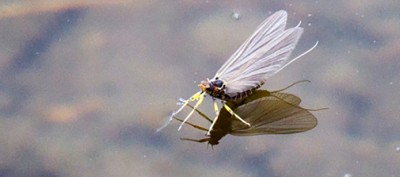
Green, Brown, and Gray Drakes are all size twelve or larger and the effect they have on trout is quite different than the usual insect fare on the Henry’s Fork. The appearance of any one of the three is an event to be savored but when they are hatching simultaneously, it can be almost more than one can bear.
Green Drakes are mostly a morning affair while Brown Drakes usually appear at around dusk. When combined with the Gray variety that can be found from late morning until dark, this impressive trio represents as much as a twelve hour window of what can seem almost suicidal behavior on the part of the trout.
For angler and river guide alike, the days become a frantic scramble from one location to another, and the distance between hot spots vary as much as forty miles. Deserving or otherwise, everyone seems to be catching trout of a size that normally would be considered an impressive accomplishment by even the most experienced veteran. Forgotten are the days when anything short of perfection in tackle or talent is met with utter distain by the snooty rainbows and browns of the upper and lower Henry’s Fork. Reality has a way of coming around, however, and that is where we are right now.
It is amazing how small a size 14 Flav or Callibaetis can seem when you have become accustomed to fishing flies that are several sizes larger. PMDs in size 18 and the even smaller Tricos become almost invisible while abrupt adjustments are forced upon Drake spoiled anglers. But the river is much quieter now, and the big trout are still there.
Most of those whom only a few days ago, were celebrating the bounty of the Henry’s Fork are now off chasing Golden Stones and Salmon Flies on the Madison or Yellowstone. And while fishing here has resumed its normal demanding ways, it is still a fine time to be on the river. Hunting big trout along the open banks is now less likely to be disturbed by human competition, and the quiet is undoubtedly enjoyed equally by both angler and trout. Maybe I don’t miss the Drakes so much after all.
Comments (0)
July 29, 2009
"Year of the Farmer" by Tyler Treece
Call it a long distance release. Call it breaking off or coming unbuttoned, call it a fast hook set, a whiff, a miss or even bad luck, call it whatever you want. We call it farming,and let me tell you I might as well plant a bunch of seeds and watch them grow the way we’ve been losing fish. When I am ninety years old and my mind has faded into a blurred archive of memories I will remember the summer of 2009 as being the year of the farmer. Its ramped, the farming that is, to the point where we’ve almost stopped joking about it. There was a particularly bad two day stretch where I went 0 for 13, farming fish left and right - I just couldn’t land a fish. Yes they’re big, yes it's difficult, and I know that's why we call it fishing and not catching, but come on, everyone needs a little lovin’ sometime.
At the beginning of the season we weren’t too concerned with the amount of big fish we were losing. So many are around, we figured it was a matter of time before we landed them all. The Predator, Brad Miller, had a good few weeks of farming early on. He would come into the shop after being on the water, arms spread out smiling ear to ear talking about the fish that were kickin’ his butt. Tom Watkins would entertain us daily with stories of losing big fish. He talked of hooking brutes that he knew from the first jump he had no chance of landing save a prayer. My brother Dylan came back from a trip with Marty Reed in absolute pain over losing three of the biggest fish he has ever had on. I have watched almost every Trout Hunter employee that fishes farm a big fish on this river this year already. They say these fish have a Ph.D. -- they certainly make it tough to say the least.
One of the worst farming streaks I personally witnessed was accomplished by an Argentine guide by the name of Alex Knull.
Visiting for a few months and unemployed, Alex and I became good friends as he was always up for going fishing. The guy can flat out fish with the best of them, but for some reason over three rough days of hard fishing he had not landed a trout. We floated the Box, we stalked Pinehaven, and on the last day we crept the banks of Last Chance looking for a brute among the rocks. I had found three rising fish in the morning and one in the afternoon and somehow landed them all. Alex had not been so lucky. The sun was falling and we were walking back to get food and some beer when he decided to look for a fish he had missed earlier. The fish was back and he was active.
First fly over his head was a Flav and he ate it casually. Alex set the hook like it was a hundred pound tarpon and his flyless line came right back at him. The fish stayed, and with a new piece of jewelry in his jaw he kept feeding. An ant was next. Over his head it went, and up he came to eat, but the set came a little fast. Never eating the same fly twice, Alex was forced to change. Three more flies, three more eats, three more misses. I gave up and started walking toward the restaurant, got just across the river and heard a whistle.
Alex was picking a twenty one inch rainbow out of the water and holding it in the sun. I couldn’t see his face but I knew he was smiling, he seemed to admire that fish a bit more than usual before he let it go.
My particular streak started and ended around the Wood Road area of the Henry’s Fork. I have worked hard this season to learn all the different stretches of river, but my favorite plan for a play day always includes creeping through the weeds around Wood Road. Big, smart, spooky fish live there, and if you fish it right you have the opportunity to catch the fish of a lifetime on the surface with light line. Fishing it right and catching fish don’t always go together however, as of recently I have found that to be all too true.
Almost every morning for the last three months has started with a little wet wading for me. The cold shoots up your legs and into your neck making it feel like cold electricity is lighting up your nerves.
Entering the water that first morning woke me up better than anything else could have. I was feeling a little overly confident about my abilities at the time, we had been catching a fair amount of big fish so far and I felt that I had found my cast and had my timing down on my hook set. Things were really goin’ good, comin’ up Tyler if you know what I mean. Thirteen big fish in two days would put me in my place.
My first cast lay out perfectly over the head of one of the biggest fish I have seen so far. He came up and ate my Flav spinner without hesitation, head as wide as a fist, and I struck him solidly in the jaw. Curved steel in an undesired place, the giant fish leapt straight up as if to check out what chump was trying to catch him this time and then took off upstream. A couple seconds and a hundred and ten feet later my line floated back to me limp as a noodle. Weeds, no flies. Three fish were still rising above me and I shrugged off my loss, happy to have fooled him in the first place. I tied on my last Flav and went to work on the next guy, a solid eighteen incher who ate the third drift I put over him. I felt two bumps and my line shot back above my head, snaked up and twisted from a badly tied knot. A little frustrated and impatient my next go to was a Harrop PMD pattern Rich Paini had suggested I try earlier in the week. There were more PMD’s on the water than Flavs, and although fish were eating both they hardly ever let a Flav pass by them uneaten, making it much more important to time up a rising fish with a PMD pattern. My third fish didn’t seem to want to eat regularly, many flies would pass him by before he would lazily return to the surface to gulp down another bug.
Cast after cast went unnoticed, although a couple were dragging slightly there was no reason for him to refuse them all. Finally while I was watching another fish feed upstream he decided it was time to eat my fly, and the second his nose broke the water I set the hook so fast it spooked us both. Pulled it right from his mouth.
So it went, ten more fish and two days later I was once again humbled by this river. Breaking the streak was a solid 16 incher that wanted my caddis so badly he left me no chance to mess it up. I fought him carefully but landed him quickly, and took my time to enjoy his beauty and reflect on the moment. I felt like a had broken a curse, or passed a test the river was giving me. I sometimes ask myself why I have chosen a life catching fish only to release them, but find that question easy to answer when I am in the water reviving a played trout. Only when taking into consideration the fact that we have intentionally made it as hard as possible to catch these fish does it make sense that we keep returning to the water. The thrill of the opportunity, however slim, to land a big trout on the fly keeps a fire lit within me to keep fishing. I’m sure if we caught every one it would be quite a bit less interesting.
Call it a long distance release. Call it breaking off or coming unbuttoned, call it a fast hook set, a whiff, a miss or even bad luck, call it whatever you want. We call it farming,and let me tell you I might as well plant a bunch of seeds and watch them grow the way we’ve been losing fish. When I am ninety years old and my mind has faded into a blurred archive of memories I will remember the summer of 2009 as being the year of the farmer. Its ramped, the farming that is, to the point where we’ve almost stopped joking about it. There was a particularly bad two day stretch where I went 0 for 13, farming fish left and right - I just couldn’t land a fish. Yes they’re big, yes it's difficult, and I know that's why we call it fishing and not catching, but come on, everyone needs a little lovin’ sometime.
At the beginning of the season we weren’t too concerned with the amount of big fish we were losing. So many are around, we figured it was a matter of time before we landed them all. The Predator, Brad Miller, had a good few weeks of farming early on. He would come into the shop after being on the water, arms spread out smiling ear to ear talking about the fish that were kickin’ his butt. Tom Watkins would entertain us daily with stories of losing big fish. He talked of hooking brutes that he knew from the first jump he had no chance of landing save a prayer. My brother Dylan came back from a trip with Marty Reed in absolute pain over losing three of the biggest fish he has ever had on. I have watched almost every Trout Hunter employee that fishes farm a big fish on this river this year already. They say these fish have a Ph.D. -- they certainly make it tough to say the least.
One of the worst farming streaks I personally witnessed was accomplished by an Argentine guide by the name of Alex Knull.
Visiting for a few months and unemployed, Alex and I became good friends as he was always up for going fishing. The guy can flat out fish with the best of them, but for some reason over three rough days of hard fishing he had not landed a trout. We floated the Box, we stalked Pinehaven, and on the last day we crept the banks of Last Chance looking for a brute among the rocks. I had found three rising fish in the morning and one in the afternoon and somehow landed them all. Alex had not been so lucky. The sun was falling and we were walking back to get food and some beer when he decided to look for a fish he had missed earlier. The fish was back and he was active.
First fly over his head was a Flav and he ate it casually. Alex set the hook like it was a hundred pound tarpon and his flyless line came right back at him. The fish stayed, and with a new piece of jewelry in his jaw he kept feeding. An ant was next. Over his head it went, and up he came to eat, but the set came a little fast. Never eating the same fly twice, Alex was forced to change. Three more flies, three more eats, three more misses. I gave up and started walking toward the restaurant, got just across the river and heard a whistle.
Alex was picking a twenty one inch rainbow out of the water and holding it in the sun. I couldn’t see his face but I knew he was smiling, he seemed to admire that fish a bit more than usual before he let it go.
My particular streak started and ended around the Wood Road area of the Henry’s Fork. I have worked hard this season to learn all the different stretches of river, but my favorite plan for a play day always includes creeping through the weeds around Wood Road. Big, smart, spooky fish live there, and if you fish it right you have the opportunity to catch the fish of a lifetime on the surface with light line. Fishing it right and catching fish don’t always go together however, as of recently I have found that to be all too true.
Almost every morning for the last three months has started with a little wet wading for me. The cold shoots up your legs and into your neck making it feel like cold electricity is lighting up your nerves.
Entering the water that first morning woke me up better than anything else could have. I was feeling a little overly confident about my abilities at the time, we had been catching a fair amount of big fish so far and I felt that I had found my cast and had my timing down on my hook set. Things were really goin’ good, comin’ up Tyler if you know what I mean. Thirteen big fish in two days would put me in my place.
My first cast lay out perfectly over the head of one of the biggest fish I have seen so far. He came up and ate my Flav spinner without hesitation, head as wide as a fist, and I struck him solidly in the jaw. Curved steel in an undesired place, the giant fish leapt straight up as if to check out what chump was trying to catch him this time and then took off upstream. A couple seconds and a hundred and ten feet later my line floated back to me limp as a noodle. Weeds, no flies. Three fish were still rising above me and I shrugged off my loss, happy to have fooled him in the first place. I tied on my last Flav and went to work on the next guy, a solid eighteen incher who ate the third drift I put over him. I felt two bumps and my line shot back above my head, snaked up and twisted from a badly tied knot. A little frustrated and impatient my next go to was a Harrop PMD pattern Rich Paini had suggested I try earlier in the week. There were more PMD’s on the water than Flavs, and although fish were eating both they hardly ever let a Flav pass by them uneaten, making it much more important to time up a rising fish with a PMD pattern. My third fish didn’t seem to want to eat regularly, many flies would pass him by before he would lazily return to the surface to gulp down another bug.
Cast after cast went unnoticed, although a couple were dragging slightly there was no reason for him to refuse them all. Finally while I was watching another fish feed upstream he decided it was time to eat my fly, and the second his nose broke the water I set the hook so fast it spooked us both. Pulled it right from his mouth.
So it went, ten more fish and two days later I was once again humbled by this river. Breaking the streak was a solid 16 incher that wanted my caddis so badly he left me no chance to mess it up. I fought him carefully but landed him quickly, and took my time to enjoy his beauty and reflect on the moment. I felt like a had broken a curse, or passed a test the river was giving me. I sometimes ask myself why I have chosen a life catching fish only to release them, but find that question easy to answer when I am in the water reviving a played trout. Only when taking into consideration the fact that we have intentionally made it as hard as possible to catch these fish does it make sense that we keep returning to the water. The thrill of the opportunity, however slim, to land a big trout on the fly keeps a fire lit within me to keep fishing. I’m sure if we caught every one it would be quite a bit less interesting.
Comments (2)
July 19, 2009
Box Canyon: The water releases from the Island Park Dam are a bit higher than normal for this time of the year (1390 cfs). Fishing in the "Box" continues to be very good to excellent. The most productive fishing has been with small, size 16 and 18, tungsten beadhead nymphs. Some of our favorite nymph patterns include black Krystal Zebra Midges, brown standard Zebra Midges, Flashback PT's, and Prince nymphs. During the past week anglers have also reported a few good catches on adult golden stone imitations. As usual we have also had reports of some large fish being taken on streamers. We recommend olive Sculpzilla's, olive Sculpin Leeches, olive Big Gulp Sculpin's and olive and white Double Bunnies.
Last Chance/Railroad Ranch/Wood Road: Fishing on the "Ranch" has been good with PMD and Flav (LIttle Western Green Drake) spinners in the mornings (8 a.m. to Noon) and again in the evenings (7 p.m. to 9:30 p.m.). Also, during the evenings, you want to make sure you have some Flav emergers and adults to cover the actual hatch. During the middle of the day plan on walking the banks and looking for those fish that are active mid-day. Most of those mid-day fish are probably looking for beetles or ants. Make sure you have a few size 12 Jake's Beetles and a Ninja Cicada or two. Sight nymphing with PT and Turkey Tail nymphs has produced some nice fish down in the Wood Road area. There has been a pretty decent Gray Drake hatch going on down around the Pinehaven area over the past couple of days. Plan on having a size 12 or 14 Gray Drake Blind Man Spinner in your box if you happen to be around this hatch. There have also been quite a few caddis around all up and down this section of the river so don't forget your caddis imitations either.
Riverside to Hatchery Ford/Cardiac Canyon: Fishing in both of these sections of the river has been excellent with dry flies, nymphs and streamers. Some of our favorite dry flies at this time of year include the Hedgehog Golden Stone, Berrett's Hairy Yellow Sally, the Lime Trude, Royal Trude, and E-Z Caddis. Small (size 8 and 10) rubber legs and size 16 tungsten beadhead nymphs are your best choice in nymphs. Olive and tan colored streamers work well here also.
Warm River to Ashton: Fishing on this section of the Henry's Fork remains excellent. Dry flies, streamers and nymphs of various kinds are all producing good numbers of trout here. Be prepared to hook your share of whitefish if you decide to nymph but you will catch trout as well.
Ashton to Saint Anthony: Fishing down on this section of the river has been best in the mornings and evenings with PMD's and Rusty Spinners. Try beetles, ants and hoppers during the middle of the day
Other Area Waters: Madison River (Montana): The salmon flies are out from the West Fork to below Hebgen Lake. This hatch tends to bring out the crowds so don't expect to have the river to yourself. There are also golden stones, yellow sallies, PMD's and caddis hatching all up and down the river. Fishing has been excellent in spite of the crowds.
Slough Creek (YNP): Green Drakes and PMD's are hatching and the fish are on them. The river is still a little high but that's a good thing. Bring plenty of bug dope if you head to this special destination.
Last Chance/Railroad Ranch/Wood Road: Fishing on the "Ranch" has been good with PMD and Flav (LIttle Western Green Drake) spinners in the mornings (8 a.m. to Noon) and again in the evenings (7 p.m. to 9:30 p.m.). Also, during the evenings, you want to make sure you have some Flav emergers and adults to cover the actual hatch. During the middle of the day plan on walking the banks and looking for those fish that are active mid-day. Most of those mid-day fish are probably looking for beetles or ants. Make sure you have a few size 12 Jake's Beetles and a Ninja Cicada or two. Sight nymphing with PT and Turkey Tail nymphs has produced some nice fish down in the Wood Road area. There has been a pretty decent Gray Drake hatch going on down around the Pinehaven area over the past couple of days. Plan on having a size 12 or 14 Gray Drake Blind Man Spinner in your box if you happen to be around this hatch. There have also been quite a few caddis around all up and down this section of the river so don't forget your caddis imitations either.
Riverside to Hatchery Ford/Cardiac Canyon: Fishing in both of these sections of the river has been excellent with dry flies, nymphs and streamers. Some of our favorite dry flies at this time of year include the Hedgehog Golden Stone, Berrett's Hairy Yellow Sally, the Lime Trude, Royal Trude, and E-Z Caddis. Small (size 8 and 10) rubber legs and size 16 tungsten beadhead nymphs are your best choice in nymphs. Olive and tan colored streamers work well here also.
Warm River to Ashton: Fishing on this section of the Henry's Fork remains excellent. Dry flies, streamers and nymphs of various kinds are all producing good numbers of trout here. Be prepared to hook your share of whitefish if you decide to nymph but you will catch trout as well.
Ashton to Saint Anthony: Fishing down on this section of the river has been best in the mornings and evenings with PMD's and Rusty Spinners. Try beetles, ants and hoppers during the middle of the day
Other Area Waters: Madison River (Montana): The salmon flies are out from the West Fork to below Hebgen Lake. This hatch tends to bring out the crowds so don't expect to have the river to yourself. There are also golden stones, yellow sallies, PMD's and caddis hatching all up and down the river. Fishing has been excellent in spite of the crowds.
Slough Creek (YNP): Green Drakes and PMD's are hatching and the fish are on them. The river is still a little high but that's a good thing. Bring plenty of bug dope if you head to this special destination.
Comments (0)
Blog Archive
- Fishing Report (47)
- Harrop's Forked Tongues (8)
- TroutHunter News (8)
- TANGLES - guides' blog (9)
- Shop Talk (9)
- Upcoming Events (15)
- Travelogue (6)
- 1970 (1)
- April (1)
- 2008 (35)
- March (3)
- April (5)
- May (7)
- June (5)
- July (5)
- August (4)
- September (3)
- October (3)
- 2009 (25)
- February (4)
- March (1)
- April (2)
- May (1)
- June (5)
- July (5)
- August (3)
- September (1)
- October (2)
- November (1)
- 2010 (13)
- January (1)
- February (2)
- May (2)
- June (2)
- July (2)
- August (2)
- October (2)
- 2011 (24)
- February (1)
- March (2)
- April (2)
- May (1)
- June (4)
- July (2)
- August (3)
- September (3)
- October (3)
- November (1)
- December (2)
- 2012 (4)
- January (4)
Stream Flows
- HENRY'S FORK below I.P. Reservoir
-
Flow (cfs): 542
- HENRY'S FORK below Ashton Dam
-
Flow (cfs): Ice
- HENRY'S FORK at St. Anthony
-
Flow (cfs): Ice
- FALLS RIVER NEAR Chester
-
Flow (cfs): Ice
- MADISON below Hebgen Lake
-
Flow (cfs): 1150Temperature (°F): 36.5
| Join Our Mailing List |


